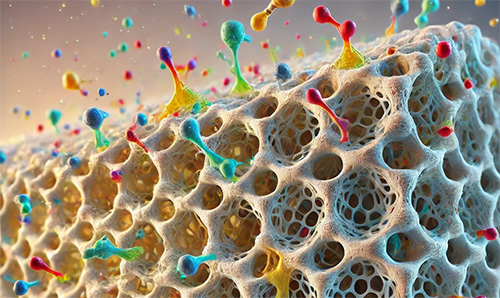
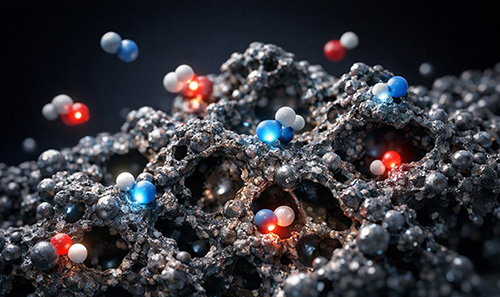
Our advanced sorption technology enables precise gas and moisture analysis, measuring CO₂/H₂O sorption isotherms, kinetics, and breakthrough curves. These tools support Direct Air Capture (DAC) research, porous material characterization, and optimization of sorbents for efficient real-world carbon capture performance.
DVS enables sensitive two-component vapour/gas sorption measurements, supporting moisture analysis and multicomponent adsorption isotherms. This allows real-time evaluation of materials such as zeolites for VOC capture, helping characterize performance under realistic conditions and optimize pollutant-removal materials.
Water sorption kinetics are key to material stability and physiochemistry. DVS measures water sorption isotherms, hysteresis, and reversible or irreversible processes, providing insights into hydration effects. In pharmaceuticals, hydration impacts solubility, flowability, and dissolution, while DVS-derived kinetic data allow calculation of diffusion coefficients for powders and fibers.
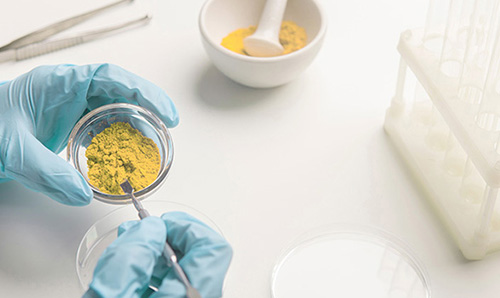
Relative humidity strongly affects the glass transition temperature (Tg) of amorphous compounds, influencing stability, performance, and shelf life. Water acts as a plasticizer, potentially triggering phase transitions in pharmaceutical powders. Our techniques enable detailed moisture analysis, hygroscopicity testing, and mapping of amorphous-to-crystalline transitions in APIs.
Moisture affects product formulation, stability, and performance. DVS and iGC-SEA assess drying, powder adhesion, and protein stabilizer effects while providing surface energy characterization. In personal care, DVS measures moisture content and drying rates in creams, and iGC-SEA evaluates interactions with surfaces like hair fibers.
Vapor pressure defines the equilibrium between a material’s vapor and condensed phases. Understanding vapor sorption reveals material–vapor interactions. Accurate measurement, using instruments like a Vapor Pressure Analyzer, is crucial for industries such as agrichemicals, ensuring thermodynamic stability, safety, and quality of solids and liquids.
Total surface energy reflects a solid’s activity, cohesion, and adhesion, influencing powder flow, aggregation, and blending performance. iGC-SEA assesses surface energy, powder cohesion, and polymer adhesion, while moisture analysis shows humidity effects. These measurements inform fibre processability, polymer–composite interactions, and sorption kinetics for optimized material performance.
Characterizing surface energy and porosity is key for understanding material performance. DVS and iGC-SEA enable BET surface area determination and adsorption capacity analysis while preserving material structure. Differentiating dispersive and specific surface energy components informs polarity, wettability, and interactions within porous materials.
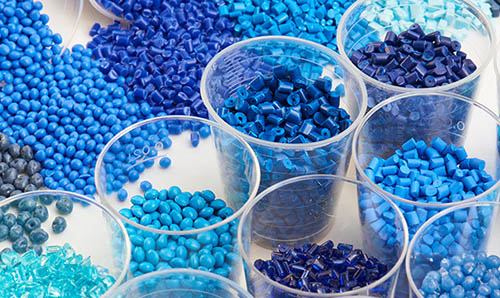
Polymers’ performance and stability are influenced by surface heterogeneity, solvent/moisture uptake, and swelling, affecting surface area, energy, and transport properties. Techniques like iGC and DVS enable rapid measurement of diffusion rates, solubility parameters, surface energy, adhesion, cohesion, and wettability, supporting polymer–solvent interaction analysis and formulation optimization.
Materials continuously interact with moisture and volatiles, affecting surface area, surface energy, wettability, and stability. Drying or dehydration can alter crystal structure or hydration state. In pharmaceuticals, hydration influences stability, solubility, and dissolution. Techniques such as DVS enable precise moisture analysis to monitor hydrate formation, loss, and sorption behavior.
Diffusion and mass transfer influence material stability and performance by governing gas/vapor exchange with surfaces and bulk structures. Techniques such as DVS measures sorption kinetics, vapor transport, and breakthrough adsorption. These analyses help evaluate permeability, product lifetime, and barrier properties in sectors including pharma packaging, membranes, food, and cosmetics.
A material’s sorption capacity, governed by surface chemistry, area, and porosity, influences performance, lifespan, and activity. DVS enables detailed moisture analysis, providing adsorption isotherms and sorption kinetics to understand vapor uptake and equilibrium, helping predict behavior of materials such as building composites under varying environmental conditions.
Batch-to-batch variation in active materials, caused by processing, amorphous content, or polymorphism, can lead to physicochemical instability and phase changes. Differences in moisture uptake, sorption behavior, and surface properties often drive these issues. Sensitive techniques such as DVS and iGC-SEA enable detailed moisture, sorption, and surface energy analysis to detect and characterize subtle processing variations.
Amorphous materials can form during processes such as milling, spray drying, or granulation and can significantly influence hygroscopicity, glass transition temperature, stability, and product performance, even at low levels. Techniques such as DVS and iGC enable sensitive measurement of amorphous content, supporting analysis and optimization in pharmaceutical formulations.
Solubility impacts drug bioavailability, formulation stability, and shelf life across pharmaceuticals, cosmetics, food, and materials. Techniques like DVS and iGC-SEA assess sorption behavior, while solubility parameters help predict material miscibility, penetration of gases into solids, and compatibility in formulations and blends.