
Breakthrough Analysis (BTA)
Breakthrough analysis is a method used in adsorption and separation science to evaluate how well a packed bed sorbent adsorbs gases or vapors under dynamic flow through conditions thus closely mimicking real world process environments.
What is BTA?
Breakthrough analysis is a method used in adsorption and separation science to evaluate how well a packed bed sorbent adsorbs gases or vapors under dynamic flow through conditions thus closely mimicking real world process environments.
- Global Application
An essential laboratory solution for directly evaluating multicomponent uptake in sorbents under real-world conditions delivering critical insights into gas and vapor adsorption, selectivity, and kinetics within simulated process environments.
Common Applications for Breakthrough Analysis?
Surface energy (γ) is the principal characteristic measured by iGC. Analogous to surface tension in liquids, it measures the attractive intermolecular forces on a solid surface. These forces are responsible for attraction between powder particles and other molecules via long-range van der Waals forces (dispersion) and short-range chemical forces (polar).
Determining CO2 uptake under real-world conditions
Determine reactivity and competitive adsorption
Determine Hygroscopicity and sorption capacity
Measure selective & competitive adsorption
Accurately determine permeability and filtration
Measure competitive and selective adsorption
How does BTA work?
In a typical Breakthrough Analysis (BTA) experiment, a controlled gas mixture containing known concentrations of target gases and/or vapors is passed through a packed column of porous sorbent material under continuous flow. As the mixture interacts with the sorbent, the outlet stream is continuously monitored to track changes in concentration.
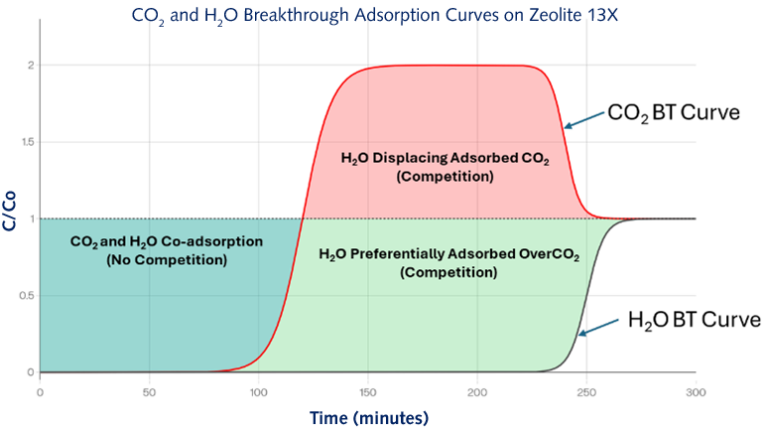
The resulting plot of adsorbate concentration versus time called breakthrough curve provides powerful insight into sorbent performance under realistic operating conditions.
The typical breakthrough process evolves through three key stages:
-
Complete AdsorptionThe sorbent fully captures the target species, with no detectable presence at the outlet.
-
Breakthrough PointThe target adsorbate begins to appear at the outlet, indicating the onset of sorbent exhaustion and reduced capture efficiency.
-
SaturationThe sorbent reaches full capacity, allowing the adsorbate to pass through freely at inlet concentration.
What sets our Breakthrough Analysis apart?
What unique innovative features have Surface Measurement Systems brought to Breakthrough Analysis?
Integrated Sensor Suite
Built-in CO2, Relative Humidity, VOC, NH3, H2S and TCD sensor options, Software integrated MS option.
Multi-gas Versatility
Up to 5 inlets for CO2, He, VOCs, N2, trace NH3, NOx, H2S, and SOx.
Precision Vapor Control
Water vapor generation range of 0-95% RH.
Wide Sample Amount Choice
20 mg to 3000 mg sample capacity
Dual-Column Productivity
2-column system with customizable SS & glass options.
Wide Temperature range
Column over up to 500 oC with 5-60 oC incubator
Advanced Breakthrough Curves
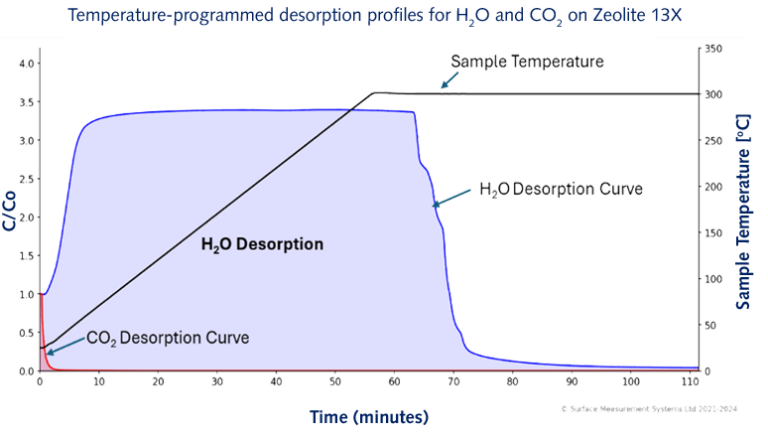
BTA Frontier enables multicomponent adsorption studies, revealing competitive, non-competitive, and synergistic interactions, along with detailed Temperature Programmed Desorption (TPD) analysis for comprehensive adsorption characterization
BTA Frontier
BTA Frontier redefines adsorption breakthrough analysis, delivering unmatched precision in packed bed testing under real-world conditions. With advanced sensors for CO₂, H₂O, and organic vapors, it accurately measures competitive adsorption across various gases and vapors, enabling detailed insights into sample properties and performance.
Designed for efficiency, the BTA Frontier features a dual-sample column for increased throughput, supporting multi-component uptake studies with precise gas-phase mixing and adsorbate detection. Its temperature and flow control ensures exceptional accuracy and confidence in your results.
- Single/Multi-Component Breakthrough Analysis
- Elevated Throughput
- Customizable Sensor Array




Talk to Our Scientists Today
World-class gravimetric vapor sorption analyzers and inverse gas chromatography instruments designed for precision.