
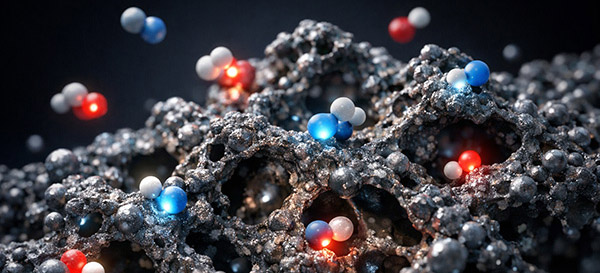

Quantify how amorphous content influences moisture uptake and stability using DVS and iGC. Gravimetric vapor sorption provides the most sensitive sorption isotherms and kinetic measurements, enabling detection of low levels of amorphous material, supporting optimization of processing conditions and prediction of shelf-life performance.

Characterize surface heterogeneity and energy distributions with iGC. Understanding dispersive and acid–base surface properties enables optimization of powder flow, blending, and adhesion, critical for improving formulation performance and consistency.

Simulate real-world storage and handling conditions using controlled humidity and temperature cycling. Sorption-desorption studies provide insight into hysteresis, structural changes, and long-term stability, guiding packaging and environmental control strategies.
Evaluate the impact of moisture and temperature on glass transition behavior. Measure glass transition (TgRH) shifts under controlled humidity, helping define important processing and storage conditions to maintain physical stability.